


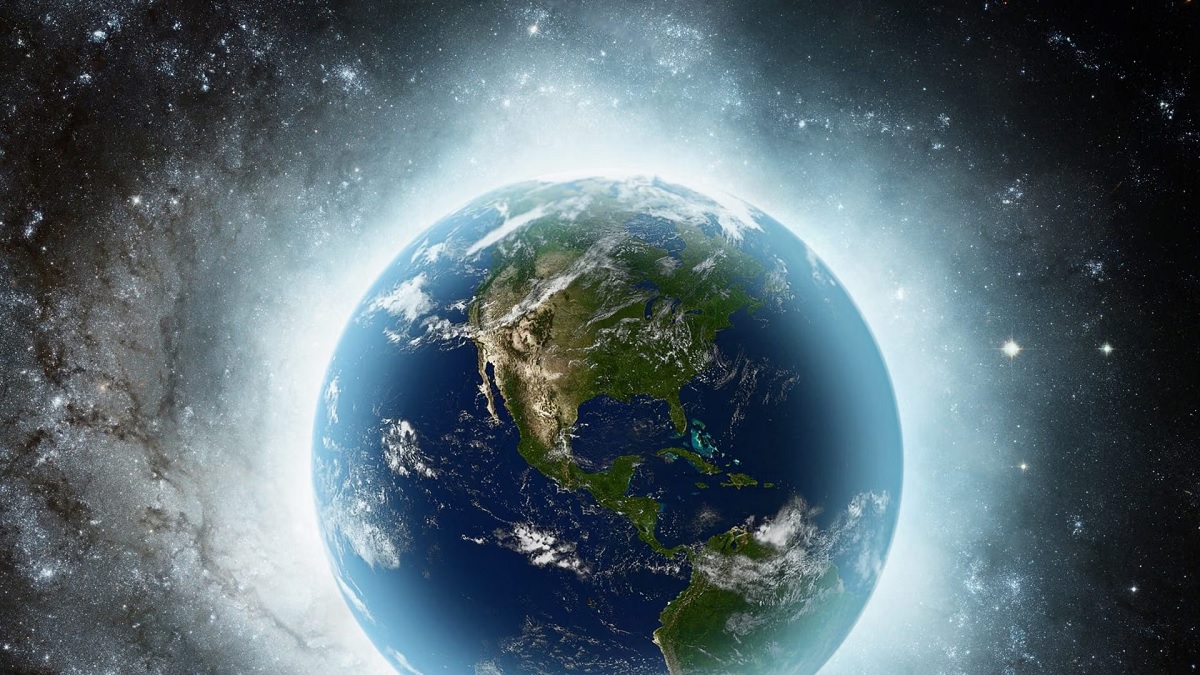
Before the story of life on Earth can start, something has to exist for life to happen in. Episode 1 of Martin Jenkins‘s “The First Spark” goes back before any of that: past the planet, past the sun, past even the atoms that would eventually build both, to a universe with nothing in it at all.
It starts 13.8 billion years ago. Everything that would ever exist, every atom, every star, every ocean, traces back to a single event and the chain of collisions and near-misses that followed it. None of it was aimed at producing anything in particular. Life is what happened to be possible once enough of that debris settled down.
From Nothing to a Universe
The Big Bang put every future ingredient of the cosmos into play within a fraction of a second. In roughly a billionth of a trillionth of a trillionth of a second, the universe expanded by a factor of around 10^26, an episode of inflation so extreme that the tiny quantum fluctuations present at that instant were stretched into the seeds of every galaxy that would ever form. What followed was a seething plasma of subatomic particles too hot for atoms to hold together at all.
That changed within about 20 minutes, when the plasma cooled enough to forge hydrogen and a little helium, the only two elements the early universe was capable of building. Atoms themselves didn’t fully form until roughly 380,000 years later, when the universe cooled further and electrons finally settled into orbit around nuclei. That moment released a burst of light that had been trapped in the plasma until then, light still detectable today as the cosmic microwave background, the oldest light astronomers can observe.
Stars took much longer to arrive. For as much as 100 to 300 million years, the universe sat dark, its hydrogen clouds slowly collapsing under gravity until they grew dense enough to ignite. Only once the first stars switched on did galaxies begin gathering out of that cosmic web, one of them an unremarkable spiral that would eventually be called the Milky Way.
A Solar System Assembles From Debris
Roughly 9 billion years passed between the first galaxies and the event that mattered most for this story: a collapsing cloud of gas and dust within the Milky Way condensing into a star. The sun ignited, and the material left spinning around it in a disc began the slow process of clumping together, dust into pebbles, pebbles into small rocky bodies. Collisions and mergers repeated until four inner planets stood where there had only been drifting debris.
Earth was one of them, and it built its final shape through repeated violence. Impact after impact melted large sections of the young planet, and as that material stayed molten, heavy metals like iron and nickel sank toward the center while lighter rock floated upward. Earth’s layered structure, a metal core, a rocky mantle, and a thin crust, was set by that separation and hasn’t fundamentally changed since.
The Collision That Made the Moon
The single biggest impact came around 4.5 billion years ago, when a body roughly the size of Mars struck the young Earth at a glancing angle. Researchers have given that impactor a name, Theia, even though nothing that could be called Theia survives intact anywhere in the solar system today. Estimates of its size vary, with some models putting its mass as low as a tenth of Earth’s and others closer to half, but the outcome is not seriously disputed: the collision ejected a huge volume of debris from both bodies, and that debris eventually gathered into the Moon.
Simulations suggest Theia’s own material could account for as much as 70 to 90 percent of the Moon’s total mass under the classic version of the impact model, and scientists have debated for years whether the strike was a glancing blow or closer to head-on. Evidence reported in 2016, drawn from isotope patterns in lunar and terrestrial rock, tipped the argument toward a more direct hit, with material from Theia scattered through both the Earth and the Moon rather than concentrated in one or the other. More recent work has gone looking for Theia’s remains inside Earth itself, with some researchers proposing that unusual, dense regions deep in the lower mantle may be leftover fragments of the impactor that never made it into orbit. Where Theia itself was assembled is still debated too. Some models place its origin at one of the stable Lagrange points along Earth’s own orbit, while others argue it formed farther out in the solar system and only later crossed paths with the young Earth.
Whatever its exact geometry, the impact left Earth with something that mattered for everything that came after: a moon large enough to stabilize the tilt of Earth’s axis. A stable tilt means a stable climate, and a stable climate is one of the quieter preconditions life would eventually need.
A Long-Debated Bombardment
The solar system didn’t calm down once the Moon formed. Sometime between roughly 4.1 and 3.8 billion years ago, both the Earth and the Moon appear to have been struck by a spike in impacts, an episode known as the Late Heavy Bombardment. The main evidence comes from lunar rock brought home by the Apollo missions: when researchers dated the impact melt in those samples, ages clustered heavily between about 3.8 and 4.1 billion years old, and lunar meteorites collected since have turned up few if any ages older than roughly 3.9 billion years, a pattern consistent with a genuine spike rather than a random scatter.
Not every planetary scientist accepts that the spike was real. Critics have argued that the clustering could be a statistical illusion, the product of sampling debris thrown out from a single large impact rather than evidence of a solar-system-wide bombardment. Others favor a more gradual decline in impacts stretching from around 4.2 billion years ago to 3.5 billion years ago, rather than one concentrated event. The debate remains open, and it matters for this story because a true bombardment spike would have meant a more hostile stretch for any early chemistry trying to get started, while a longer, gentler tail-off would have left more room for it.
The Crystals That Rewrote Early Earth
For most of the 20th century, scientists pictured early Earth as a world so hostile that geologists nicknamed the era after Hades. Small crystals found in a stretch of Western Australia called the Jack Hills forced a reconsideration. Zircon grains recovered there have been dated to as old as roughly 4.375 billion years, plus or minus about 6 million years. They’re the oldest confirmed fragments of the planet found so far.
Geochemist John Valley of the University of Wisconsin-Madison led a 2014 study, published in Nature Geoscience, that used atom-probe tomography to examine individual lead atoms locked inside one of these zircons. The crystal’s internal dating record, the study confirmed, had stayed reliable for more than 4 billion years. The trace elements inside pointed to an origin in water-rich, granite-like rock, evidence that Earth had cooled enough to support surface water and continental-style crust within roughly 100 million years of the Theia impact, far sooner than the Hadean nickname implied. Valley put it plainly: the zircons suggest the earliest Earth was more like the Earth known today than like the molten wasteland once assumed.
That evidence doesn’t settle the Late Heavy Bombardment debate, but it does narrow what’s at stake in it. If oceans and continental crust existed this early, then whatever the bombardment turned out to be, gentle or violent, brief or drawn out, life’s chemistry would have had real water and real rock to work with far earlier than 20th-century geologists ever expected.
Naming Life Before It Existed
One piece of this story isn’t geological at all. Before any account of how life began can proceed, it needs a working definition of what counts as alive, and a way to keep track of that life once it starts multiplying into new forms. That framework arrived far more recently than anything else in this episode. In the 1750s, the Swedish naturalist Carl Linnaeus published the works that established binomial nomenclature, the two-part naming system that still assigns every species, plant, animal, or microbe, a genus and a species name today. Systema Naturae was published first, in 1735, and Species Plantarum followed in 1753, with each edition adding more organisms to a single, shared classification scheme. Before Linnaeus, naturalists across Europe were using their own inconsistent, often paragraph-long descriptions for the same organisms, and comparing notes between them wasn’t simple. Linnaeus wasn’t describing early Earth or reconstructing ancient chemistry. He was building the vocabulary future scientists would need once life needed to be sorted, named, and compared.
What This Sets Up
By the end of Episode 1, none of the ingredients for life have actually combined yet. What exists is a planet with a stabilizing moon, a crust cooled enough to hold liquid water, an atmosphere and a bombardment history still argued over by specialists, and, thanks to Linnaeus, a naming system waiting for something to describe. None of these pieces were built with a destination in mind, and it’s worth sitting with how much had to happen first: a universe stretched into existence, a star ignited, a planet nearly destroyed and then stitched back together with a moon watching over it. The next episode in the series picks up the question this one leaves open: how, on a planet this young and this recently battered, chemistry first crossed over into biology.
