


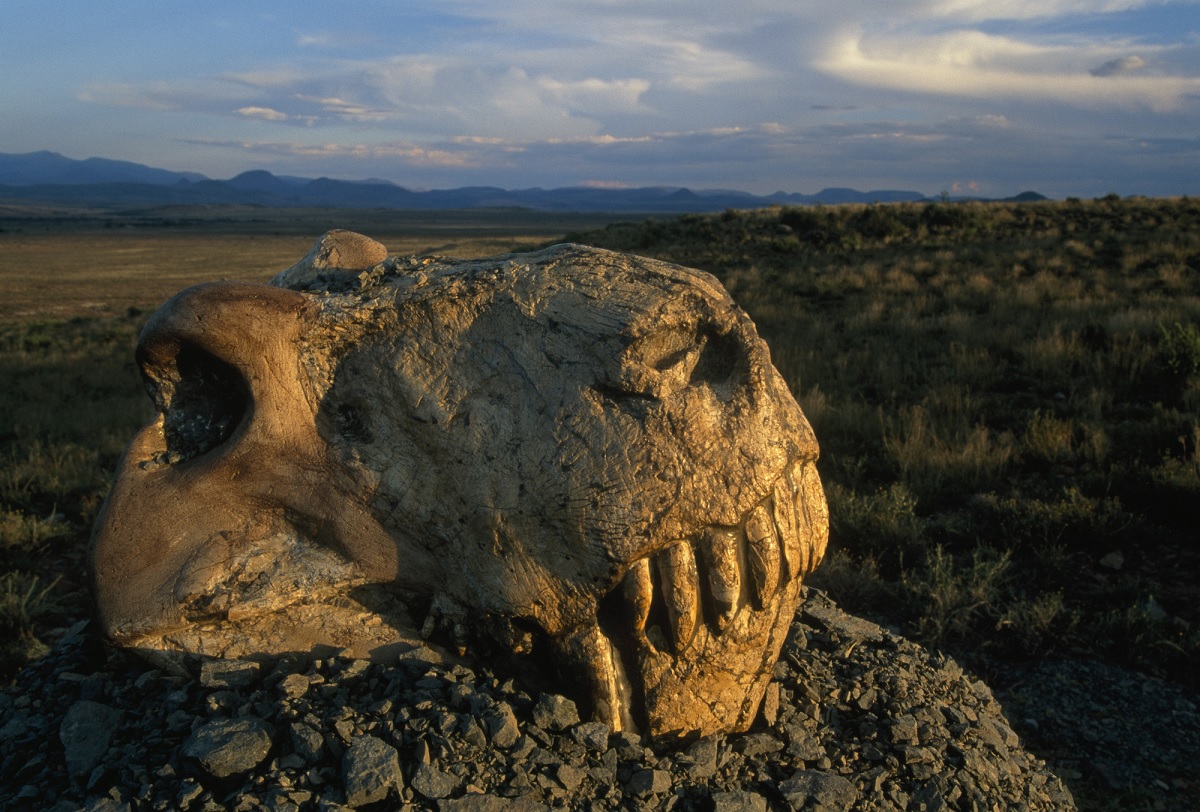
About 252 million years ago, volcanic eruptions in Siberia set off a chain of events that wiped out, by most estimates, more than 90 percent of species on Earth. Episode 7 follows the end-Permian extinction from a thriving supercontinent to a planet of a few hardy survivors.
A World Ruled by Our Distant Relatives
Earth 252 million years ago had one landmass. Pangaea ran almost the full length of the globe, north to south, and a single ocean called Panthalassa wrapped around it. Far from any coast, the interior turned to desert, with hot summers and freezing winters. Animals could live there because of an earlier innovation. By around 312 million years ago, in the Carboniferous period, some vertebrates had begun laying amniotic eggs, which hold their own water and protective membranes. Their young no longer needed a pond to develop in, so their parents could move inland.
Those egg-layers split into two lineages. Sauropsids are the ancestors of today’s lizards and birds, and of the dinosaurs in between. Synapsids, identified by one skull opening behind each eye socket, are the line that leads to mammals, and so to us. During the Permian period, which ran from about 298.9 to 251.9 million years ago, the synapsids were the dominant large animals on land.
They came in forms that look strange to modern eyes. Earlier in the Permian, the sail-backed Dimetrodon hunted the floodplains of what is now Texas. Despite its reptilian outline, it was more closely related to mammals than to any living lizard or crocodile, and it disappeared about 40 million years before the first dinosaurs. By the Late Permian, the tusked, plant-eating dicynodonts grazed the landscape, while the saber-toothed gorgonopsians sat at the top of the food chain. The largest of these, Inostrancevia, reached about 3.5 meters long and 300 kilograms, with long canine teeth and a jaw that could open past 90 degrees. This world was well established and had been for millions of years. Deep underground, though, something was building that would bring it to an end.
Fire Beneath Siberia
The trigger lay in what is now Siberia. This was not a single volcano but a vast field of fissures where the ground split open and lava poured out in repeated pulses. Geologists call the resulting rock formation the Siberian Traps. The pulses went on for hundreds of thousands of years at the very least, and many estimates stretch the whole episode to about two million. By the end, roughly 4 million cubic kilometers of lava covered about 7 million square kilometers of Siberia, more ground than the continental United States.
Where the magma rose mattered as much as how much there was. Beneath the Tunguska Basin lay thick beds of coal and evaporite salts. Molten rock forced its way through them and baked them, and the carbon and sulfur they held escaped as carbon dioxide, sulfur dioxide and methane.
The cause wasn’t always so clear. Since the 1980s, researchers had argued over an asteroid, volcanoes, or both. Dating work at Meishan in China helped decide it. There, the first fossils of a small eel-like conodont, Hindeodus parvus, define the official base of the Triassic worldwide.
Volcanic ash beds at Meishan contain zircon crystals, which can be dated with uranium and lead. They put the extinction at 251.902 million years ago, a date with unusually tight error bars for something so old. Zircons from the Siberian Traps, dated the same way, show the eruptions were under way at the same time. A nickel-isotope study reported around 2019 found a chemical signal in the boundary rocks that fit volcanic gases, not an impact. Most geologists now treat volcanism as the main driver.
A Planet’s Chemistry Breaks Down
As the gases accumulated, the atmosphere began to change. Carbon dioxide levels are estimated to have risen from about 400 parts per million to as much as 2,500. A runaway greenhouse effect took hold, and global surface temperatures climbed by roughly 8 to 10 degrees Celsius.
Plant cover on land probably died back under acid rain. A thinned ozone layer may also have let in more ultraviolet light. Animals already short of food in the heat had little margin left. The sea fared worse.
The Oceans Suffocate
Warm water holds less dissolved oxygen than cool water, and as the oceans absorbed heat and carbon, they began to lose the oxygen that marine life depended on. A 2018 study in Science by Justin Penn and Curtis Deutsch of the University of Washington simulated seas that warmed by about 11 degrees Celsius in places and lost, on average, 76 percent of their dissolved oxygen. In their model, that oxygen loss was the main killer of marine life. The deep water in about 40 percent of the ocean ended up with no oxygen at all.
The extra carbon also made seawater more acidic. That was especially damaging for corals, shellfish and other animals that build shells and skeletons from calcium carbonate, because acidic water makes those structures harder to form. In the stagnant, oxygen-starved depths, some bacteria released hydrogen sulfide, a gas that is poisonous to most life.
Most of the killing at sea seems to have happened within 60,000 to 100,000 years, a short span by the standards of the rock record. Up to 96 percent of marine species were lost. That top figure is debated, and a 2016 reanalysis by Steven Stanley of the University of Hawaii put the marine toll nearer 81 percent. Either way, no other extinction emptied the oceans so thoroughly.
Lystrosaurus and the Disaster Fauna
Which animals lived through it owed a good deal to luck. The synapsid dynasty that had run Pangaea was nearly wiped out, though the gorgonopsians lasted into the last act. Christian Kammerer and Pia Viglietti, writing in Current Biology in 2023, described Inostrancevia fossils from South Africa’s Karoo Basin. They turn up in layers above the last native gorgonopsians. Kammerer and Viglietti read this as a Russian predator travelling some 7,000 miles (about 11,000 kilometers) south to take over a vacant role. It did not hold that role for long.
The best-known survivor is Lystrosaurus. This dicynodont was about a meter long and pig-sized, with a blunt, beaked face, two tusks and a talent for digging. Why it pulled through is still an open question. One long-standing idea, which the episode repeats, is that a barrel chest, big lungs and a life spent partly in burrows suited it to air that was poor in oxygen and full of toxic gases.
Then it multiplied. In some South African rock layers laid down just after the extinction, Lystrosaurus makes up an estimated 95 percent of land vertebrate fossils, a level of dominance by one genus with no known match. Paleontologists call animals like this disaster fauna, opportunists that flourish when a mass extinction has cleared away their competitors.
A Slow Recovery and a New Order
Nothing bounced back quickly after the most severe extinction Earth has seen. For about five million years the oceans stayed short of oxygen, and marine life had to wait. The pace differed by region. Ecosystems in some places were working again after 1 to 4 million years. The total number of marine species took around 75 million years to reach its old level, which it did only in the Middle Jurassic.
The extinction also changed which groups would dominate the land. With the synapsids reduced to a few lineages, space opened up for the sauropsids. Over millions of years in the Triassic period, that branch diversified, and among its descendants were the first dinosaurs. The age of reptiles that followed was in large part a product of the end-Permian extinction.
Echoes Today
All life on Earth now, people included, comes from the few survivors of 252 million years ago. Mammals have a closer tie still. A rock hyrax on a Karoo outcrop and the person photographing it both belong to the synapsid line that ruled the Permian and nearly vanished at its end.
The Permian also shapes the modern world in more direct ways. The Permian Basin of West Texas and southeastern New Mexico, named for its thick layers of Permian-age rock, is the largest oil-producing region in the United States. Organic material buried in Permian seas, transformed by heat and pressure over more than 250 million years, still powers vehicles and generators today.
Curtis Deutsch, co-author of the 2018 ocean-oxygen study, has drawn a comparison with the present. Human-caused warming, he has noted, has already lowered ocean oxygen by about 2 percent over the past 50 years. That is far smaller than the 76 percent loss modeled for the end-Permian, but the mechanism is related. The Great Dying shows how a rapid rise in carbon dioxide can push the atmosphere and oceans past thresholds that take millions of years to recover from. That record is preserved in rock layers in China, South Africa and Siberia, and it is still being studied today.
Watch next. In Episode 8, Age of Dinosaurs Part 1, the survivors inherit an empty world, and the sauropsids begin the long rise that will put the dinosaurs in charge of the planet.
The Story of Life on Earth is an independent, unofficial documentary series built from original research. It is not affiliated with any publisher, author, or existing book or series.
